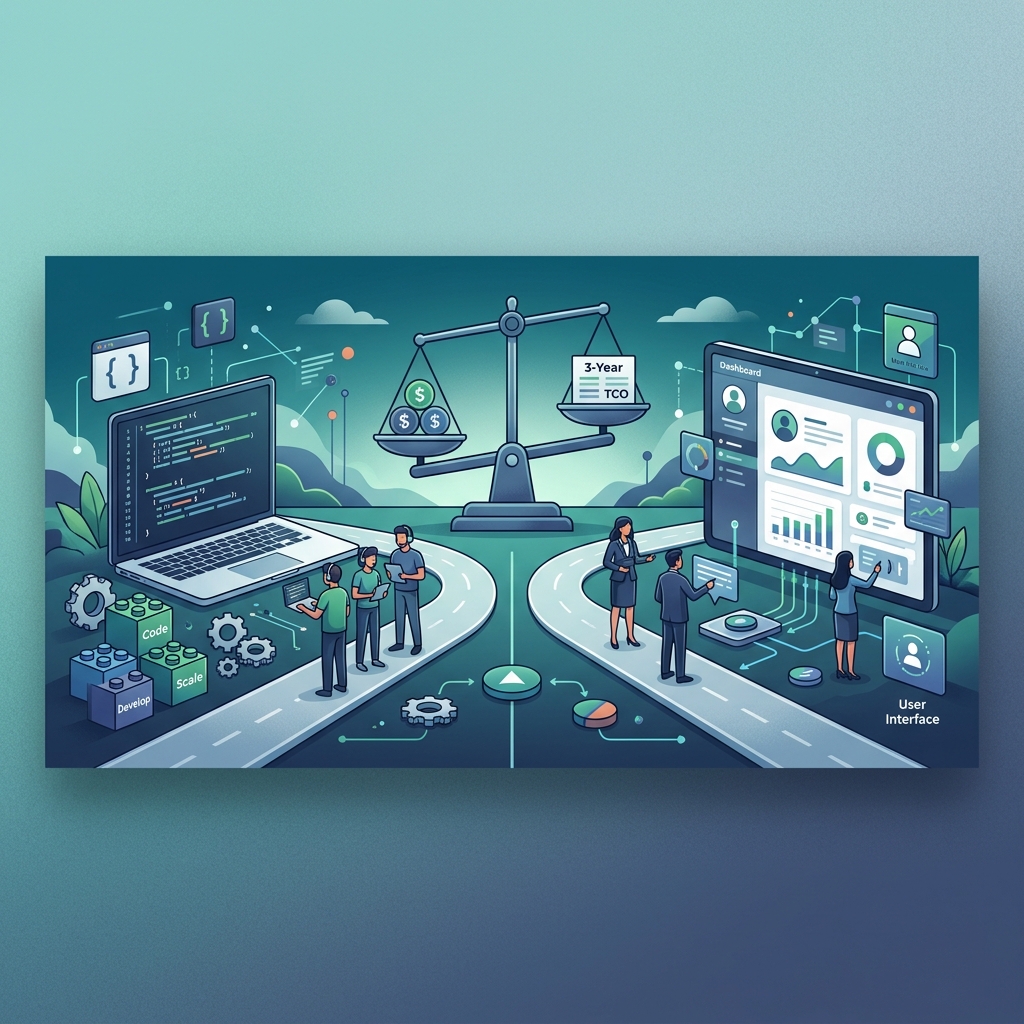
It's a familiar conversation in growing companies. You find an off-the-shelf HR platform that covers 80% of what you need, but misses on 20%. Someone in the room says: "What if we just built our own? We could make it perfect for our workflow."
The build vs. buy decision in HR tech feels like it should be close. It rarely is. In our analysis of 150+ companies that considered building custom HR systems, only 3 actually built and maintained one successfully. The other 147 either bought after failed build attempts, or are still running broken, unmaintained homegrown systems.
This guide walks through the decision framework that actually works, with real cost analysis and honest accounting of what each path requires.
The Seductive Case for Building
The appeal of custom HR tech is real. You'd build exactly what you need. No compromises. No paying for features you don't use. No frustrating integrations with your other systems. It sounds perfect.
But this thinking misses several hard truths about HR software.
HR Software Is More Complex Than It Looks
Most people dramatically underestimate the complexity of HR systems. A payroll system alone requires:
- Multi-state tax withholding (50 different tax codes)
- Annual tax updates (every state changes tax rules, usually annually)
- Federal and state compliance reporting (940, 941, UI, W-2)
- Direct deposit, ACH integration, and banking security
- ADP, Social Security, and E-Verify integration
- Year-end reconciliation and audit trails
A single payroll system is a 2-3 year build for a competent team of 3-4 engineers. And that's just payroll. Add benefits administration, benefits compliance (ACA reporting), benefits eligibility logic, employee self-service, time tracking, integrations, security, and you're looking at a 4-5 year, multi-million dollar build.
Compliance Doesn't Stop Updating
Every year, federal regulations change. Every state updates its tax code (multiple times per year). ACA compliance requirements shift. Leave laws change. Remote work rules shift. A custom HR system requires a dedicated compliance team just to keep up with regulatory changes.
An off-the-shelf platform has a dedicated team of people whose only job is tracking regulatory changes and pushing updates. A custom system requires you to replicate that.
This is where most homegrown systems fail. They work fine for 2 years, then a tax rule changes, nobody updates the code, and suddenly you're filing incorrect tax returns.
The companies that successfully maintain custom HR systems are almost always large enough to justify a dedicated 3-4 person team whose sole job is regulatory compliance and system maintenance. Everyone else eventually burns out and switches to buying.
The Total Cost of Build
Let's cost out a custom HR system realistically.
Year 1-3: Development
Assume you're building a core HR system with payroll and benefits administration. You need:
- Product manager (1 FTE): $150K/year
- Software engineers (3-4 FTE): $450K/year
- QA/tester (1 FTE): $80K/year
- Infrastructure/DevOps (0.5 FTE): $75K/year
- Compliance specialist (0.5 FTE): $60K/year
Year 1 development cost: ~$815K in payroll alone, plus infrastructure, tools, and overhead. With fully-loaded costs (benefits, taxes, equipment), assume $1.2M-1.5M per year.
Conservative estimate: 3 years, $4M to build a system comparable to a mid-market HR platform like BambooHR or HiBob.
Year 4+: Ongoing Maintenance and Compliance
Once built, you need a team to keep it updated. The absolute minimum is 2 engineers plus 1 compliance specialist, permanently. Cost: $400K-500K per year forever.
The Real Cost Analysis
| Timeline | Build Cost (Cumulative) | Buy Cost (Annual × Years) | Buy Cumulative Cost |
|---|---|---|---|
| Year 1 | $1,500,000 | $400,000 (100 employees × $4 PEPM) | $400,000 |
| Year 2 | $3,000,000 | $800,000 | $1,200,000 |
| Year 3 | $4,500,000 | $1,200,000 | $2,400,000 |
| Year 4 | $5,000,000 | $1,600,000 | $4,000,000 |
| Year 5 | $5,500,000 | $2,000,000 | $6,000,000 |
| Year 10 | $9,500,000 | $4,000,000 | $15,000,000 |
Wait, this looks like build might make sense eventually, right? At year 10, build is $9.5M and buy is $15M cumulative. But this analysis is missing something critical.
The Hidden Costs of Build
The analysis above only includes direct development costs. The real costs are much higher.
Opportunity Cost of Engineering Time
Those 3-4 engineers building HR tech could be building product features that generate revenue. If your core business makes $1M per engineer in incremental revenue annually, dedicating 4 engineers to HR tech for 3 years is a $12M opportunity cost.
This is the cost that executive leadership often conveniently forgets in build vs. buy decisions.
Distraction Cost
Once you're running a custom HR system, operational HR issues become engineering problems. An employee calls HR with a payroll discrepancy. That's now a ticket in your engineering queue. A tax audit happens. That's engineering time investigating old code.
This ongoing distraction slows down your core product development.
Risk of System Failure
A payroll system failure is a company-wide crisis. If your custom system has a bug that prevents payroll from running, you've got a $100K+ liability immediately. Off-the-shelf platforms have redundancy, backup systems, and dedicated ops teams. Custom systems often don't.
Talent Acquisition and Retention Risk
Good engineers don't want to work on HR backend compliance code. It's not exciting. Your best engineers will leave. You'll attract engineers who can't find jobs elsewhere. After 3 years, you've built an HR system that's being maintained by a team of people you'd rather not have.
The True Cost-Benefit of Buy
Let's reframe the buy option honestly.
Annual Cost for a 200-Person Company
- Core HRIS: $7 PEPM = $1,400 × 12 = $16,800/year
- Payroll processing: $6 PEPM = $1,200 × 12 = $14,400/year
- Benefits administration: $4 PEPM = $800 × 12 = $9,600/year
- Time tracking: $3 PEPM = $600 × 12 = $7,200/year
- Total all-in: ~$48,000/year
For $48K/year, you get:
- Annual tax code updates for all 50 states
- Compliance reporting that changes with law
- Direct deposit and ACH integration
- 99.9% uptime with redundancy and disaster recovery
- Employee self-service portal
- Benefits eligibility automation
- Audit trails and regulatory compliance
- 24/7 support team
The Hidden Value of Buy
The cost savings compared to build aren't just the $48K/year. The benefits are:
- Your 3-4 engineers work on your core product (potentially $3M+ in value annually)
- Zero operational distraction from HR system failures
- Regulatory compliance is handled by the vendor's team
- You can scale from 50 to 5,000 employees without rebuilding
- You can integrate with 100+ other tools automatically
The true cost difference between build and buy isn't the direct software cost. It's the opportunity cost and operational risk.
When Build Might Actually Make Sense
There are scenarios where custom HR tech is justified. They're rare, but they exist.
Scenario 1: You're a 5,000+ Person Company with Niche Needs
If you're a very large company with regulatory requirements no vendor handles well (example: a pharmaceutical company with complex clinical trial payroll), custom might make sense. You have the scale to justify a permanent compliance team. Example: Uber, Google, and Meta build custom HR systems because their scale and complexity justify it.
For most companies under 2,000 people, this doesn't apply.
Scenario 2: You're Building a Vertical SaaS for HR Functions
If you're building a SaaS product that includes HR features as part of your core offering (example: a construction management platform with integrated timekeeping and payroll), building HR tech is part of your product roadmap. This is a business decision, not an infrastructure decision.
Scenario 3: You Have an Exceptional Ops Team
If you already have an ops team that loves maintaining systems, has deep compliance knowledge, and can dedicate permanent resources, custom might work. But this is vanishingly rare.
The 80/20 Rule in HR Software
The common reason companies consider building is that off-the-shelf solutions cover 80% of their needs but miss 20%.
This is actually not a reason to build. Here's why:
- The missing 20% is usually niche: Your payroll has a custom calculation, your benefits structure is unusual, your org chart is complex. These aren't common enough to build from scratch for.
- You can integrate custom tooling: Need a custom payroll calculation? Build a lightweight integration that feeds into the main system. Need a custom benefits structure? Most platforms allow configuration without code.
- The 80% you get covers the hard stuff: Tax compliance, regulatory reporting, direct deposit, integrations — these are all handled. You're not rebuilding them.
If you could solve your needs by configuring an off-the-shelf platform plus a lightweight integration or two, that's always cheaper than building the entire system.
Find the Right Balance of Build and Buy
Our Vendor Matcher helps you identify platforms that cover your core needs, so you can focus custom development on what truly differentiates your business.
Find Your Right-Sized Solution →Decision Framework: Build vs. Buy
Use this framework to decide:
Build if:
- You're a 5,000+ person company with niche regulatory requirements no vendor serves well
- You have a permanent ops team of 3+ people dedicated to HR systems
- Your HR requirements are truly unique and represent competitive advantage
- You've calculated the opportunity cost and still prefer it
Buy if:
- You're under 5,000 people (this applies to 99% of companies)
- You want your engineers working on your core product
- You need compliance to be someone else's problem
- You want to scale without rebuilding
- You want integrations with 100+ tools to be automatic
For 99% of companies, the decision is obvious: buy. The 1% where build makes sense are usually companies large enough that they've already built it.
The Most Common Mistake: Build to Buy
The worst outcome is trying to build for 2-3 years, then switching to buy anyway. You've spent $5M+ and solved zero core business problems.
The companies that do this usually took this path:
- Year 1: Start building, convince everyone it's a great idea
- Year 2: System is working for 80% of use cases, but full of bugs and gaps
- Year 3: New executive realizes the system is a drag on the business, recommends switching
- Year 4+: Integration nightmare moving to buy, data migration headache, $2M extra cost to fix
The cost of switching from build to buy is often higher than the original build cost.
The Bottom Line
HR software is one of the rare categories where "build vs. buy" has a clear answer for most companies: buy. The total cost of ownership for buying is 60-70% lower than building when you include opportunity cost and operational risk.
The 20% of functionality you feel you're missing can almost always be solved with configuration, integration, or a lightweight custom tool that sits on top of the platform.
Save your engineers for problems only your company can solve. HR compliance isn't one of them.